


"Akutni i hronični stres: mehanizmi regulacije homeostaze u akutnoj radiacionoj bolesti i dijabetesu" #143002, Project Leader: Dr. Goran Poznanović
"Ekspresija i funkcija glukokortikosteroidnog receptora i proteina toplotnog stresa u patofiziološkim stanjima i stresu." #143003, Project Leader: Dr. Gordana Matić
"Molekularna i bihevioralna istraživanja plastičnosti nervnog sistema" #143004, Project Leader: Dr. Selma Kanazir
"Interakcija glije i neurona u procesu oporavka nakon oštećenja centralnog nervnog sistema" #143005, Project Leader: Dr. Mirjana Stojiljković
"Uticaj fitoestrogena, steroidnih i peptidnih hormona na ćelije neuroendokrinog sistema" #143007, Project Leader: Dr. Milka Sekulić
"Identifikacija specifičnih gena za terapiju kancera" #143009, Project Leader: Dr. Sabera Ruždijić
"Genetička raznovrsnost u prirodnim populacijama – uloga B hromozoma" #143011, Project Leader: Dr. Mladen Vujošević
"Adaptivni značaj genetičkog polimorfizma populacija Drosophila" #143014, Project Leader: Dr. Marko Anđelković
"Efekti traumatskih, neurotoksičnih i neuroprotektivnih faktora na električnu aktivnost mozga sisara. Analiza i modeliranje" #143021, Project Leader: Dr. Milka Ćulić
"Tekuće vode Srbije - istraživanje biodiverziteta i korišćenje podataka u tipologiji, izradi ekološkog indeksa i monitoringu ekološkog statusa" #143023, Project Leader: Dr. Predrag Cakić
"Ekofiziološke karakteristike biljaka i njihov potencijal u obnavljanju biodiverziteta narušenih ekosistema" #143025, Project Leader: Dr. Pavle Pavlović
"Regulacija morfogenetskih procesa i sekundarnog metabolizma i genetičke transformacije biljaka u kulturi in vitro" #143026, Project Leader: Dr. Branka Vinterhalter
"Uticaj magnetnih polja kao ekofiziološkog faktora na različite biološke sisteme i moguća primena u biomedicini" #143027, Project Leader: Dr. Zlatko Prolić
"Fiziološka i farmakološka modulacija imunoinflamatornih i malignih bolesti" #143029, Project Leader: Dr. Stanislava Stošić Grujičić
"Svetlosna i hormonalna kontrola rastenja i razvića biljaka, razmnožavanje in vitro i ex situ zaštita retkih i ugroženih vrsta" #143031, Project Leader: Dr. Dragoljub Grubišić
"Biomedicinska ispitivanja i razvoj nekih novih psihotropnih supstanci" #143032, Project Leader: Dr. Mirko Tomić
"Fiziološki i evolucioni aspekti stresnog odgovora u prirodnim i laboratorijskim populacijama" #143033, Project Leader: Dr. Jelica Lazarević
"Uloga redoks aktivnih supstanci u procesima održavanja homeostaze živih sistema" #143034, Project Leader: Dr. Duško Blagojević
"Proučavanje poremećaja homeostaze i određivanje biomarkera oksidacionog stresa kod aerobnih organizama" #143035, Project Leader: Dr. Zorica Saičić
"Istraživanja ekotoksikoloških aspekata delovanja ksenobiotika i biotičkih agenasa na populacije mišolikih glodara" #143038, Project Leader: Dr. Dragan Kataranovski
„Evolucija u heterogenim sredinama" #143040, Project Leader: Dr. Aleksej Tarasjev
"Diverzitet vodozemaca i gmizavaca Balkanskog poluostrva" #143052, Project Leader: Dr. Miloš Kalezić
„Hemijska trauma mozga: biohemiske i kliničke posledice" #143057B, Project Leader: Dr. Ankica Jelenković
"Unapređenje proizvodnje ukrasnih biljaka primenom novih tehnologija" # TR6833B, Project Leader: Dr. Angelina Subotić.
„Biofizička istraživanja membranskih procesa. interakcija membranskih receptora i kanala sa spoljašnjim faktorima i intracelularna regulacija” # 143016. Lead Partner: Institute for Multidisciplinary Research, University of Belgrade. Project Leader: Dr. Željko Vučinić.
„Taksonomska, biohemijska i molekularna istraživanja gljiva i biološki aktivnih supstanci” #143041. Lead Partner: Faculty of Biology, University of Belgrade. Project Leader: Dr. Jelena Vukojević.
„Istraživanja diverziteta, zaštite i održivog korišćenja faune riba, kao bitnih komponenti za razvoj strategije integralnog upravljanja vodenim resursima Srbije” # 143045. Lead Partner: Institute for Multidisciplinary Research, University of Belgrade. Project Leader: Dr. Mirjana Lenhardt.
„Strukturne, hemijske i molekularne karakteristike nekih biljnih vrsta-fundamentalni značaj i primenljivost” # 143049. Lead Partner: Faculty of Biology, University of Belgrade. Project Leader: Dr. Petar Marin.
„Fiziološki, morfološki i molekulski mehanizmi termoregulacije u adaptivnim procesima izmenjene homeostaze” # 143050. Lead Partner: Faculty of Biology, University of Belgrade. Project Leader: Dr. Gordana Cvijić.
„Biofizičko neuroprofiliranje na eksperimentalnim modelima oštećenja i oporavka centralnog nervnog sistema” # 143054. Lead Partner: Faculty of Biology, University of Belgrade. Project Leader: Dr. Pavle Anđus.
„Citotoksični, citoprotektivni i imunomodulatorni efekti nanočestica” #145073. Lead Partner: School of Medicine, University of Belgrade. Project Leader: Dr. Vladimir Trajković.
„Geološka i ekotoksikološka istraživanja u identifikaciji geopatogenih zona toksičnih elemenata i prirodne radioaktivnosti u akumulacijama vode za piće u Republici Srbiji” #146021. Lead Partner: Scientific Institution Institute of Chemistry, Technology and Metallurgy, University of Belgrade. Project Leader: Dr. Milka Vidović.
„Interakcije prirodnih proizvoda i njihovih analoga sa proteinima i nukleinskim kiselinama” #142026. Lead Partner: Faculty of Chemistry, University of Belgrade. Project Leader: Dr. Dušan Sladić.
„Regulatorni peptidi u integrativnim procesima nervnog i endokrinog sistema” #145003. Lead Partner: School of Medicine, University of Belgrade. Project Leader: Dr. Vesna Starčević.
Industrial and technological progress increases the incidence of magnetic fields of different characteristics in our working and living environment. The subproject "Neurophysiological and behavioral responses of different species to external magnetic fields" (led by Dr. Branka Petković) deals with the effects of magnetic fields, particularly on the neuroendocrine system, in insects (Drosophila sp., Musca domestica, Tenebrio molitor, Baculum extradentatum, Morimus funereus,...), snail (Helix pomatia) and mammals (Rattus sp., Meriones unguiculatus). Electrophysiological studies in vitro and in vivo, histological and biochemical analyses (oxidative stress parameters, nucleotide content, gases turnover, enzyme and receptor activities), monitoring of development and behavior in selected model systems are planned. Obtained results reveal the mechanisms of magnetoreception in evolutionary distant species and whether magnetic field-induced response is unique or species-specific.
Macroautophagy (hereafter reffered to as autophagy) is a process of intracellular protein digestion in autophagolysosomes, allowing for removal of damaged proteins and preservation of energy and survival during metabolic stress, but also able to cause cell death when activated innapropriately. The main aim of the project is to establish the role of autophagy in therapy-induced death of cancer cells. The induction of autophagy and underlying molecular mechanisms will be investigated in cancer cell lines treated with various conventional (e.g. cisplatin, taxol, cytarabine, idarubicin) or experimental anticancer agents (e.g. metformin, statins, indomethacin, nanoparticles).
Our current research focuses on the neurobiology of sleep and sleep-related breathing in the animal models "in vivo" of healthy aging and neuropathology of the most common neurodegenerative diseases of elderly (Alzheimer's Disease (AD), Parkinson's Disease (PD), different types of dementia), aimed to give a new insight into understanding of normal and abnormal sleep, the mechanisms of sleep related behavioural disorders, particularly sleep apnea syndrome, and to identify the neural networks responsible for modifying the regulation of sleep and breathing pattern in different sleep/wake states.
Brain plasticity enables the brain to cope with the environment and is highly volatile in development but highly compromised during aging. The aim of our research is to understand the plastic potential of the brain in different stages of life when exposed to the external challenges. We use the application of general anesthesia (Propofol) in early development and the implementation of various dietary regimes in normal and pathological aging to understand molecular mechanisms underlying plasticity-related processes.
The research focus of this project is to highlight some cellular and molecular mechanisms which underlie neuroinflammation, to identify potential target molecules and signaling pathways. Our aim is to find adequate therapeutic approaches for sanitation of neuroinflammation and promotion of regeneration after the central nervous system (CNS) damage. The efficacy of several therapeutic approaches (purine nucleoside analogues: Ribavirin and Tiazofurin, hyperbaric oxygenation, B vitamins - B1, B2, B3, B6, B12) in suppression of detrimental and enhancement of beneficial inflammatory mechanisms is tested. Considering the pivotal role of extracellular purine nucleotides and nucleosides in the control of neurodegenerative processes and inflammatory responses a particular focus will be put on regulation of their metabolism and the role of ectonucleotidases.
Our research is focused on studying lung, breast, thyroid and brain tumors. Experimental studies include the identification of changes in genes structure, expression, and corresponding proteins function, which could be used as molecular markers for the prediction of tumor progression, response to therapy and disease outcome. By comprehensive analysis of PI3K/Akt/mTOR key molecules in the postoperative material of different tumor types and by comparative analysis of the complete genome originating from tumor and normal tissue using DNA profiling method, we managed to identify changes in DNA related to carcinogenesis and to define new candidate genes responsible for the cancer progression and resistance to therapy.
Phone: +381 11 20 78 300
Fax: +381 11 27 61 433
Email: ibiss@ibiss.bg.ac.rs
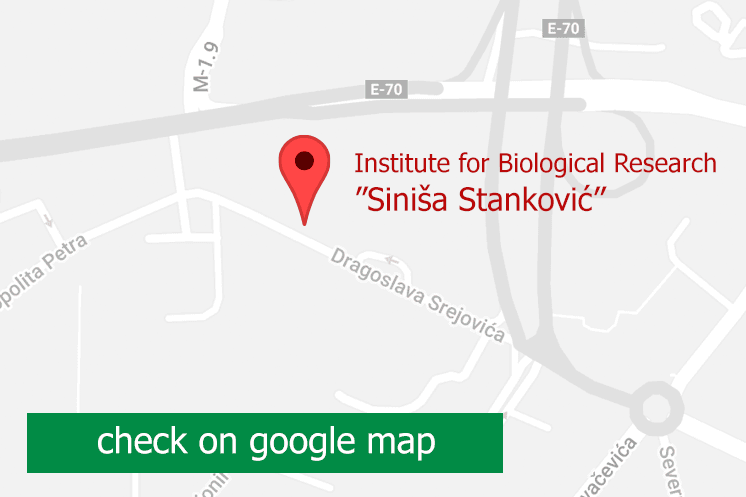
Bulevar despota Stefana 142
11108 Belgrade
Serbia


IBISS uses analytical cookies to analyze the use of the site in order to improve the user experience, by clicking "Accept" you consent to the use of cookies.